

Van Life Budget: Real Monthly Cost ($1,200–$2,500)
The real numbers from real nomads. Not the YouTube version where everything is free.
Somewhere on YouTube there's a guy in a $80,000 Sprinter conversion telling you van life costs $500 a month. He's parked on free BLM land, eating rice and beans, and his solar setup was gifted by a sponsor. He is not lying, exactly. He's just leaving out the other eleven months of the year.
The truth about van life costs is boring: it depends. It depends on how you travel, where you park, what you eat, and how often your vehicle decides to remind you that it has 187,000 miles on it. But there are real numbers, and they cluster in a range that's a lot more useful than "$500 or $5,000, who knows."
Here's what full-time van life actually costs in 2026, based on what nomads are actually spending.
The Monthly Budget Breakdown
These ranges come from the spectrum of nomad lifestyles. The low end is the boondocker who cooks every meal, moves slowly, and avoids paid campgrounds. The high end is someone who mixes campgrounds with free camping, eats out occasionally, and doesn't agonize over every gallon of gas.
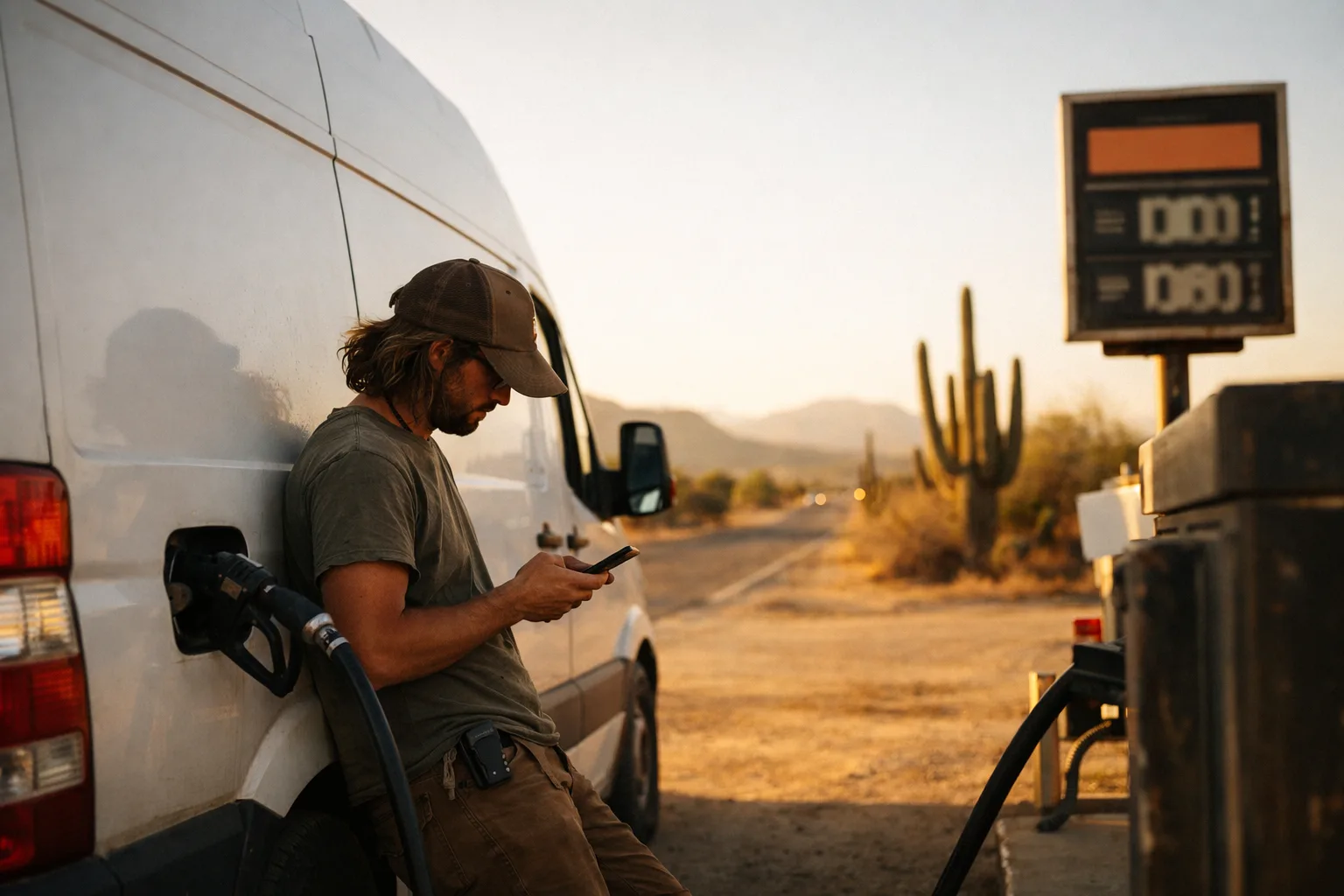
Gas: $300 - $600/mo
This is usually the biggest variable. A van getting 15 MPG that moves every few days will burn through gas fast. A converted minivan getting 25 MPG that stays put for a week at a time will spend half as much. In 2026, gas prices are averaging $3.20 - $3.80 nationally, but you'll hit $4.50+ in California and under $3.00 in Texas.
The real factor is how often you move. A nomad who drives 1,000 miles a month at 18 MPG and $3.50/gallon spends about $194. Someone doing 2,500 miles a month in a thirsty van hits $500+ easily. Most full-timers land between 1,200 - 2,000 miles per month.
Food: $300 - $500/mo
Cooking in your van saves a fortune, but it's not free. Groceries for one person run $250 - $350 if you're disciplined about meal planning and buying in bulk when you pass a Costco. Add in the occasional restaurant meal, the coffee shop where you're really paying for Wi-Fi, and the "I'm too tired to cook" fast food stop, and you're at $400 - $500.
Eating out regularly will blow this category up fast. Two restaurant meals a week adds $200 - $300/month easily.
Insurance: $100 - $200/mo
Vehicle insurance for a van or RV varies wildly by state, vehicle type, and your driving record. Full-timers with a domicile in South Dakota or Florida often pay less. A converted cargo van on a personal auto policy might run $100 - $130/month. A Class B RV on a specialty policy could hit $180 - $250.
Health insurance is the elephant in the room. If you're on an ACA marketplace plan, you're looking at $200 - $500/month depending on income and subsidies. Some nomads use health sharing ministries or short-term plans. This line item alone can swing your budget by hundreds.
Camping: $0 - $400/mo
This is where lifestyle choices matter most. Pure boondockers who stick to BLM land, national forest dispersed camping, and free overnight spots spend literally zero on camping. It's one of the most powerful levers in the van life budget.
But most people can't boondock 100% of the time. You need water fills, dump stations, shore power to catch up on work, or just a hot shower after a week in the desert. Campground fees range from $15/night for a basic state park to $50+/night for a full-hookup RV park. Even mixing in just 8 - 10 campground nights a month adds $150 - $300.
Phone and Internet: $50 - $150/mo
A basic unlimited phone plan runs $50 - $70. If you work remotely and need reliable internet, you're probably carrying a dedicated hotspot or a Starlink Mini. Starlink's roaming plan is $120/month in 2026, plus the hardware cost amortized over time. Some nomads tether from their phone and call it done. Others stack two carriers for redundancy in rural areas.
Maintenance and Repairs: $100 - $300/mo (averaged)
This one is sneaky because it doesn't hit you every month. It hits you all at once when your transmission decides to quit in rural New Mexico. The smart move is budgeting $100 - $300/month into a maintenance fund whether you spend it or not.
Oil changes, tire rotations, brake pads, and belts are the predictable stuff. The unpredictable stuff is what gets you: a water pump at 150K miles ($800), an alternator ($500 - $900), a coolant leak that turns into a head gasket conversation ($2,000+). Older vans are cheaper to buy but more expensive to keep running.
The Hidden Costs Nobody Warns You About
Every "van life budget" article covers the big six above. Here's what they skip.
Laundry: $40 - $80/mo
Laundromats charge $3 - $5 per wash and $2 - $3 per dry cycle. If you're doing laundry once a week, that's $20 - $32/month just in machine costs, plus the detergent you buy and the hours you spend sitting there. Some campgrounds have laundry facilities, but they're not free either.
Gym memberships: $25 - $50/mo
Planet Fitness at $25/month is the unofficial van life shower membership. You're not there for the gains. You're there for hot water, a clean bathroom, and sometimes the Wi-Fi. Some nomads use a nationwide gym chain specifically for this purpose. It's a real line item.
Propane: $15 - $40/mo
If you cook with propane or use it for heating, you'll refill every 2 - 4 weeks depending on usage. A 20-lb tank refill runs $15 - $25. Winter in the desert means running the heater at night, which burns through propane faster than you'd expect.
Subscriptions and tools: $30 - $60/mo
iOverlander, Campendium premium, a Harvest Hosts membership, a roadside assistance plan (Good Sam, AAA+), cloud storage for backing up your photos and work. None of these are expensive individually, but they add up to a quiet $30 - $60/month that never shows up in the glamorous budget breakdowns.
The random stuff: $50 - $100/mo
A replacement water jug because yours cracked. New fuses when something electrical goes weird. A fan belt you didn't know existed. The $45 dump station fee because the free one was closed. A parking ticket because you didn't see the "no overnight parking" sign. These irregular expenses average out to $50 - $100/month if you're honest about tracking them.
So What's the Real Total?
Adding it all up:
- Lean boondocker: $1,000 - $1,300/mo. Free camping, cooks every meal, moves slowly, does their own maintenance. This is doable but requires discipline and a reliable vehicle.
- Balanced full-timer: $1,500 - $2,000/mo. Mixes free and paid camping, eats out once or twice a week, drives a moderate amount. This is where most nomads actually land.
- Comfortable traveler: $2,000 - $2,500/mo. Campgrounds most nights, eats out regularly, doesn't stress about gas prices, has Starlink. Still cheaper than most apartments.
Health insurance can add $200 - $500 on top of any of these numbers. Vehicle payments, if you have them, add more. These totals assume you own your vehicle outright.

How to Keep Costs Down
Boondock more, campground less
Every night you spend on free public land instead of a $30 campground saves you $30. Over a month, switching from 50/50 to 80% boondocking saves $300 - $400. Apps like iOverlander and Campendium make finding free spots easier than it's ever been.
Cook in, eat out less
A decent camp stove and a cooler (or a 12V fridge if your electrical system supports it) turns your van into a restaurant that charges grocery prices. The nomads who keep food costs under $300/month are the ones eating oatmeal for breakfast, making sandwiches or wraps for lunch, and cooking one real meal for dinner.
Move slower
Every mile costs money. Gas, tire wear, oil changes, and the general entropy of putting miles on an aging vehicle. The nomads who spend the least are the ones who find a spot they like and stay for a week or two instead of driving to a new place every morning. You see more of each place, too.
Follow the seasons
The Southwest in winter, the Pacific Northwest or mountains in summer. This isn't just about comfort. It's about avoiding expensive heating in cold weather and expensive campground premiums in peak season. Snowbird migration patterns exist for a reason.
Do your own maintenance
YouTube University has a video for every van repair you'll ever face. An oil change at a shop costs $80 - $120. Doing it yourself costs $30 in oil and a filter. Brake pads, air filters, battery replacement, minor electrical work, all of it is cheaper DIY if you're willing to learn. Carry basic tools and a repair manual for your vehicle.
Van Life vs. Apartment Living: The Real Comparison
The average one-bedroom apartment in the US costs about $1,500/month in 2026. Add utilities ($150), internet ($60), renter's insurance ($15), and gas for a commute ($100 - $200), and you're at $1,825 - $1,925/month before groceries.
A balanced van life budget of $1,500 - $2,000/month is roughly the same. Van life isn't the massive savings hack that YouTube promises. It's a lateral move financially for most people.
Where it does win: no lease, no landlord, no fixed location. Your "rent" buys you a different backyard every week. And if you're disciplined about boondocking and cooking in, you can get genuinely below $1,200/month, which is hard to match with any apartment in a city worth living in.
Where it loses: no building equity, vehicle depreciation is real, and one major mechanical failure can wipe out months of savings. There's no super in the van life. You are the super.
"I tracked every dollar for my first year on the road. Average was $1,640/month. That's less than my studio apartment was, and I saw 22 states. But there were months where a $1,200 repair made it $2,800. You need a buffer."
The Number That Actually Matters
The most important number in your van life budget isn't your monthly spend. It's your emergency fund. Most experienced nomads recommend having $3,000 - $5,000 set aside specifically for vehicle repairs and unexpected costs. Without it, one bad breakdown turns your adventure into a crisis.
Van life can be genuinely affordable. It can also be genuinely stressful if you're running lean without a safety net. The nomads who last aren't the ones with the lowest budgets. They're the ones with realistic budgets and a cushion for when things go sideways.
Because things will go sideways. That's part of the deal. The other part is waking up in a national forest with no rent check due and nowhere you have to be. That part's pretty good.
Frequently Asked Questions
How much does van life cost per month in 2026?
Full-time van life in 2026 typically costs $1,200 to $2,500 per month depending on driving distance, camping choices, and food habits. Budget breakdown: gas $300-$600, food $300-$500, insurance $100-$200, camping $0-$400, phone and internet $50-$150, maintenance averaged $100-$300, plus $130-$330 in hidden costs like laundry, gym memberships, propane, and miscellaneous expenses. Tighter budgets are possible (~$900/month) by minimizing miles driven and relying on free BLM camping.
What are the hidden costs of van life nobody warns you about?
The most underestimated van life costs are: laundry ($40-$80/month at laundromats since you can't do it in the van), gym memberships used primarily for showers ($25-$50/month), propane refills ($15-$40/month), digital subscriptions and tools you'd already pay for ($30-$60/month), and miscellaneous one-off expenses like replacing a broken water jug, buying a new phone mount, or printing parking permits ($50-$100/month). These add $130-$330/month that new van lifers rarely budget for.
Is van life cheaper than renting an apartment?
Van life is typically cheaper than renting an apartment in any major US city, but more expensive than renting in low-cost rural areas. A nomad spending $1,500/month on the road beats a $2,000+ city rent + utilities + commuting setup, but loses to a $700/month rural rental. The bigger financial advantage of van life isn't monthly cost — it's eliminating the rent-trap fixed cost so you can earn flexibly and save aggressively when you do work.
How much does gas cost for full-time van life?
Gas for full-time van life typically costs $300-$600 per month, depending on miles driven and vehicle. A high-mileage Sprinter or Promaster getting 17-20 mpg, driven 1,500-2,500 miles per month at average US fuel prices, lands in the $300-$500 range. Older RVs and skoolies with 8-12 mpg can push gas to $700+. The single biggest cost lever is driving less — staying 7-14 days at each spot rather than constantly relocating cuts gas spend by 30-50%.
How can I keep van life costs down?
The largest van life cost reductions come from: (1) drive less — gas is the biggest variable, so stay longer at each spot; (2) free camp on BLM and National Forest land instead of paid campgrounds; (3) cook your own food rather than eating out; (4) batch grocery and laundry trips with fuel stops to save miles; (5) use Harvest Hosts ($99/year unlimited) for one-night farm and winery stays; (6) audit subscriptions seasonally — most can be paused. Insurance and phone are largely fixed costs.
Find nomads near you
nomatch is a verified community of van lifers, RV travelers, and digital nomads. See who's nearby, what they're down for, and connect.