
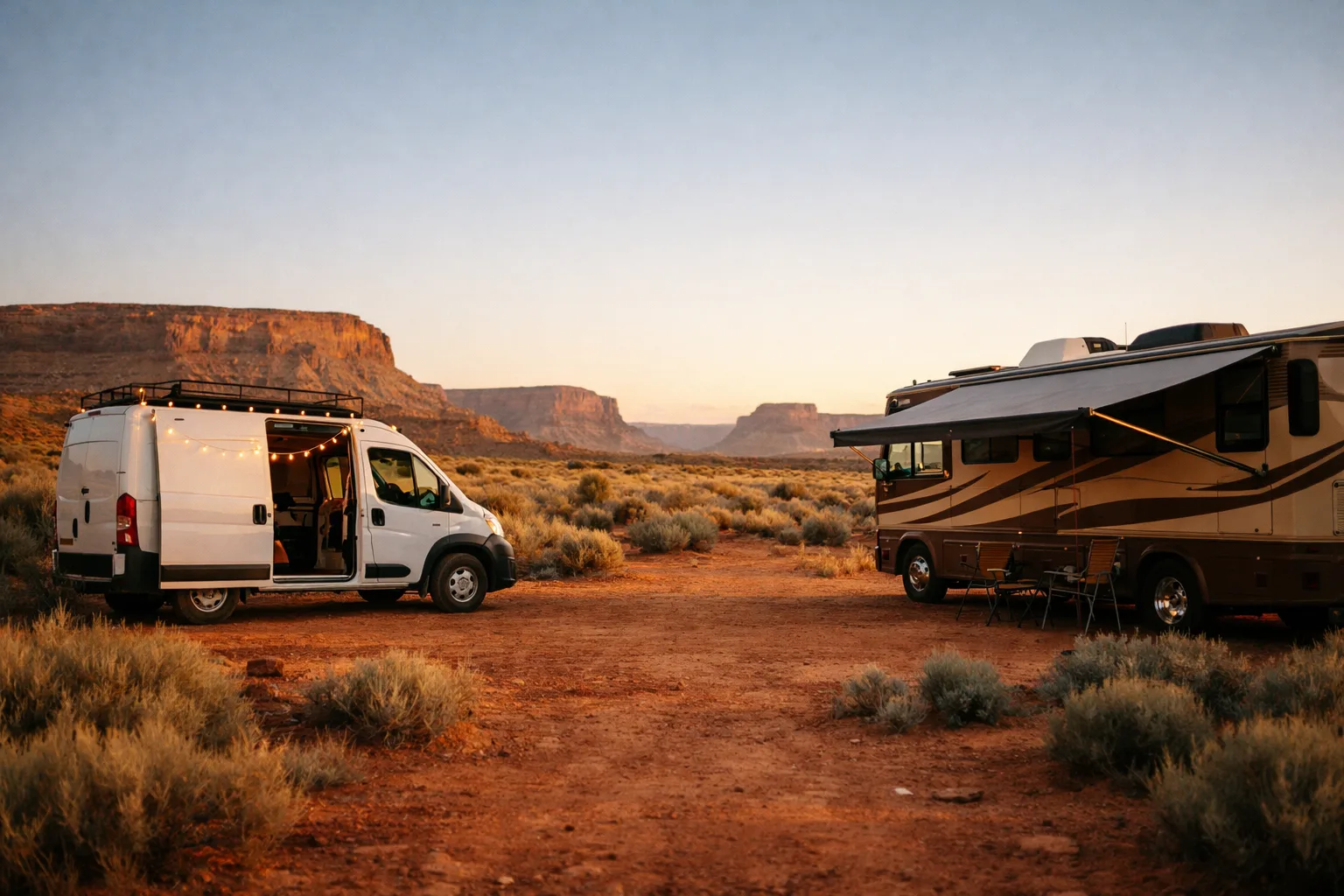
Van Life vs RV Life: Which One Is Right for You?
One fits in a parking spot. The other has a shower. Here's how to decide.
This is the question that keeps people stuck for months. They're ready to hit the road. They've watched every YouTube tour. They've priced out builds and browsed dealership lots. But they can't pull the trigger because they don't know: van or RV?
And every forum thread about it turns into tribal warfare. Van people act like RVs are bloated suburban houses on wheels. RV people act like van lifers are masochists who enjoy suffering. Neither side is being honest.
The truth is simpler. They're different tools for different lifestyles. The right choice depends on how you actually want to live on the road, not which one looks cooler on Instagram.
Cost: The Real Numbers
Let's start with the thing everyone cares about but nobody gives straight answers on.
Van life costs
A used cargo van runs $5,000 to $15,000. A professional conversion adds $20,000 to $50,000 on top of that, though plenty of people DIY for $5,000 to $10,000 in materials. A turnkey converted van from a builder? $60,000 to $150,000, depending on how many Instagram features you want.
The ongoing costs are where vans win. Gas on a four-cylinder van is manageable. Insurance is cheap because it's registered as a van, not an RV. And free camping is actually free because you fit in a normal parking spot. BLM land, national forest dispersed camping, overnight Walmart stays, rest areas. A van blends in. Nobody looks twice.
RV life costs
A used Class C motorhome starts around $20,000 to $40,000 for something that won't immediately break down. A decent used Class A runs $50,000 to $120,000. New? $80,000 to $300,000+, and that's before you tow a car behind it.
The ongoing costs add up faster than people expect. Gas on a Class A can run $0.50 to $1.00 per mile. Most RVs need campground hookups at least occasionally for water, dumping, and charging, and those run $30 to $80 per night. Maintenance on multiple systems (generator, AC, water heater, slide-outs) means something is always on the verge of breaking.

Mobility: Where You Can Actually Go
This is the dimension where vans have the clearest advantage and it's not even close.
A van fits in a regular parking spot. You can drive it through a fast food drive-through. You can park downtown, grab a coffee, use the wifi at a library, and nobody knows you live in it. Height-restricted parking garages are the only real limitation, and even that depends on your build.
An RV turns every parking situation into a project. Tight mountain roads with switchbacks? Sketchy. Cities? Forget about it unless you tow a separate car. Grocery shopping means finding a lot where you won't block six spaces or clip a light pole pulling out.
If your dream is moving frequently, exploring cities, doing spontaneous detours down dirt roads, and generally going wherever curiosity takes you, a van gives you dramatically more freedom of movement.
If you prefer settling into campgrounds for a week or two at a time, traveling between established spots on major highways, and don't mind planning your route around vehicle size, an RV works fine.
Comfort: Honest Trade-offs
This is where the RV wins and van lifers need to stop pretending otherwise.
In a van, you're standing in your kitchen while you cook. Your bed is three feet from your stove. Your "bathroom" is a bucket with a toilet seat or a gym membership. Your shower is a solar bag hanging from your roof rack or a truck stop. You learn to live small, and most people who stick with it genuinely grow to love the simplicity. But it is a trade-off, especially if you're sharing the space with a partner.
In an RV, you have a real bathroom with a door that closes. A shower with hot water. A full kitchen with a real stove, oven, and counter space. A couch. Separation between sleeping, cooking, and living areas. Air conditioning that actually works. Some Class A rigs have washers and dryers.
The comfort gap narrows in good weather. When you live outdoors, a van is a sleeping pod and a storage unit. When it rains for three days straight in the Pacific Northwest and you can't go outside? The person in the RV is watching a movie on the couch. The person in the van is going slightly insane.
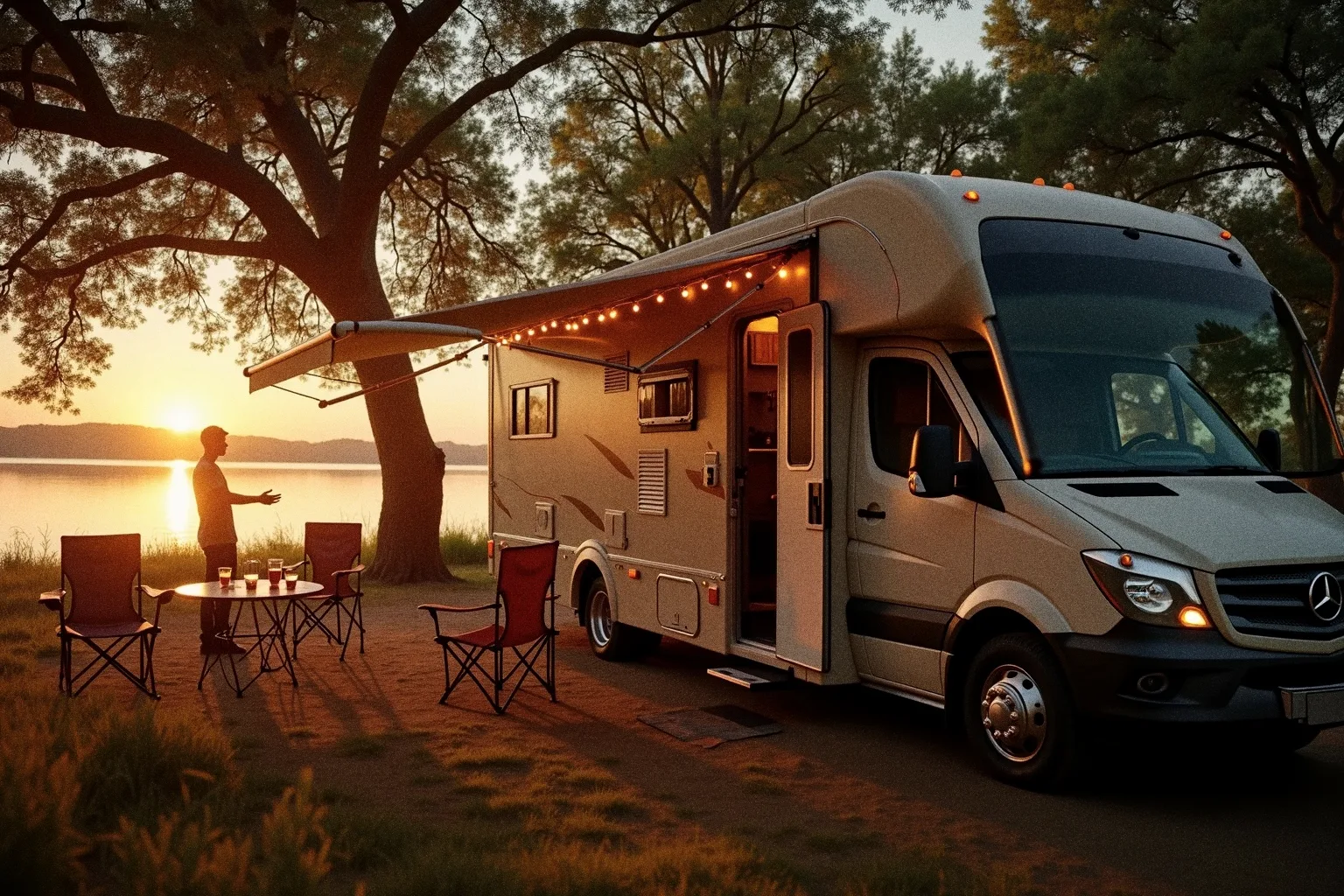
Stealth: The Invisible Advantage
Stealth camping means parking somewhere overnight without drawing attention. It's how a lot of full-time van lifers keep their costs near zero.
A plain cargo van parked on a residential street looks like a contractor's vehicle. Nobody calls the cops on a work van. Add some fake company magnets and you're invisible. This means you can sleep in cities, near trailheads, in beach parking lots, outside climbing gyms, basically anywhere with a flat surface.
An RV is the opposite of stealth. It screams "someone is living in here." You'll get knocked on at Walmart. You'll get tickets in cities. You're limited to places that explicitly welcome RVs, which usually means paying for a campground or driving to remote public land.
If you're someone who wants to drift through different places without planning every overnight stop in advance, stealth capability is a major quality-of-life feature.
Maintenance: What Breaks
A van is mechanically simple. It's a vehicle with some wood and wiring in the back. If the engine runs, you can deal with most other problems with a YouTube video and basic tools. Solar panel issue? You can troubleshoot it yourself. Water pump died? It's a $40 part and twenty minutes. The DIY culture in van life exists because most of the systems are actually DIY-able.
An RV has more systems, which means more things that break. Slide-out motors fail. Roof seals leak. Generators need servicing. Propane systems need inspection. The water heater does something weird. The leveling jacks make a noise they didn't make yesterday. And when something breaks, it's often specialized enough that you can't fix it in a parking lot. You need an RV service center, and those can have wait times measured in weeks during travel season.
This doesn't mean RVs are unreliable. It means they require more maintenance attention and the repairs tend to be more expensive and harder to DIY.
Work Setup: The Remote Work Reality
Both work for remote work, but differently.
In a van, your workspace is wherever you put your laptop. That usually means the driver's seat swiveled around, a folding table, or the bed with a lap desk. It's compact but workable. Many van lifers solve this by doing most of their work in coffee shops, libraries, and coworking spaces. The van is home base, not the office.
In an RV, you can set up a dedicated desk. A real chair. An external monitor. You have enough power for serious equipment without worrying about draining your house battery by noon. If you need to take video calls, having a stable indoor space with a consistent background matters.
If your work requires long focused hours at a desk with reliable power and internet, an RV makes that easier. If your work is laptop-based and flexible, a van plus the right coffee shop is plenty.
Community: Different Crowds, Same Roads
Both van life and RV life have massive, welcoming communities. They overlap more than people think.
Van lifers tend to skew younger, more adventurous, more budget-conscious. The community is heavy on social media, meetups at BLM land, and spontaneous gatherings. There's a strong DIY ethos and a lot of knowledge-sharing about builds, routes, and free camping spots.
RV communities tend to include more families, retirees, and people who've been on the road longer. Campground culture is social in its own way. RV parks often have communal areas, potlucks, and regulars who return to the same spots every season. Full-time RVers have their own gatherings and rallies.
But here's what matters: both groups are on the same roads, at the same overlooks, in the same small towns. The tribal divide exists mostly online. In person, a van lifer parked next to an RVer at a campsite will end up sharing a fire and trading stories. The lifestyle is the common ground, not the vehicle.
The Hybrid Options Nobody Talks About
The van-vs-RV question implies there are only two options. There aren't.
Truck campers bolt onto a pickup truck bed. You get more space than a van, the ability to detach your living space from your vehicle, and access to any road a truck can handle. They're popular with overlanders for a reason.
Class B RVs are basically large vans with factory-built interiors. They drive like vans, fit in regular parking spots, and have proper RV systems built in. They're the most expensive per square foot but the easiest transition for someone who wants van-like mobility with better build quality.
Small travel trailers give you a separate living space you can unhitch and leave at camp while you drive your truck or SUV around town. The flexibility of having a normal vehicle during the day is genuinely underrated.
Don't let the binary framing box you in. The right setup might be something in between.
Real Talk: People Switch
Here's what the "van vs RV" debate usually leaves out: plenty of people try one and switch to the other. And that's not a failure. It's information.
Some people start in a van because it's cheaper and more romantic, then upgrade to an RV after a year when they realize they want more space, hot showers, and a toilet that isn't a bag. They don't love the road less. They just know themselves better.
Some people start in an RV, get frustrated by the size limitations and campground dependency, and downsize to a van. They want to be more nimble, spend less, and get further off the beaten path.
Both directions are valid. The vehicle is not the lifestyle. The lifestyle is deciding that freedom and mobility matter more than a fixed address. The vehicle is just how you implement that decision, and you can always change the implementation.
"I started in a van, moved to a Class C after two years, and honestly I miss the van sometimes. The RV is more comfortable but the van was more fun. There's no perfect answer."
So Which One Should You Pick?
Lean toward a van if: you move frequently, value stealth and spontaneity, want lower costs, prefer cities and back roads over campgrounds, are comfortable with minimal amenities, and don't mind solving comfort problems creatively.
Lean toward an RV if: you prefer settling in for longer stays, need more space for a partner/family/pets, want a real bathroom and kitchen, do remote work that requires a stable setup, and don't mind higher ongoing costs and campground fees.
Consider a hybrid if: you want the best of both worlds and have the budget for a Class B or truck camper setup.
But honestly? The best advice anyone can give you is this: just pick one and go. You will learn more about what you actually need in two weeks on the road than in six months of research. The vehicle can be changed. The time you spend overthinking the decision cannot.
No matter what you drive, the roads are the same. The sunsets are the same. And the people you'll meet out there are the same community of weirdos who chose freedom over a lease. The rest is just details.
Frequently Asked Questions
What is the difference between van life and RV life?
Van life means living in a converted cargo van (Sprinter, Promaster, Transit) typically 18-24 feet long, focused on stealth, mobility, and reaching remote locations. RV life means living in a Class A, B, C, or trailer-based RV typically 24-40 feet, focused on comfort, space, and full residential amenities. Vans go more places, RVs are more comfortable to live in. The same person often switches between them — many full-timers downsize from RV to van or upsize from van to RV after a year of one.
Is van life cheaper than RV life?
Van life is typically cheaper than RV life on monthly operating costs — gas (vans get 17-20 mpg vs 8-12 mpg for older Class A RVs), camping (vans fit free dispersed sites RVs can't access), and maintenance (smaller systems). However, RV upfront costs can be lower if buying used (a 1990s Class C can be had for $15K vs $40K+ for a built-out Sprinter). Total cost of ownership over 3+ years tends to favor vans, especially for nomads who drive frequently.
Which is better for full-time travel: van or RV?
It depends on your priorities. Choose a van if you value: reaching remote dispersed camping, stealth in cities, lower fuel costs, easier maintenance, and tighter mobility. Choose an RV if you value: more living space, full residential amenities (bathroom, full kitchen, separate bedroom), bringing more gear, traveling with kids or pets, and longer stays at established campgrounds. Solo nomads and couples without kids skew van; families and retirees skew RV.
Where can a van go that an RV cannot?
Vans access dispersed BLM and National Forest camping that RVs typically can't reach: rough access roads, narrow forest service roads, low overhead clearance areas, tight switchbacks, and beach/coastal camping with soft surfaces. Vans also fit standard parking spaces (urban stealth camping) and most national park campsites that have RV-length restrictions. As a rough rule, anywhere you'd take a passenger SUV is van-accessible; RVs are limited to paved roads and sites built for them.
Can you switch from van life to RV life?
Yes — and many full-timers do. The common transitions: van to RV after a year (more space, more comfort, ready to settle into longer stays), RV to van after a couple of years (tired of driving the rig, want more remote access), and the hybrid approach of keeping both for different seasons. The community treats both lifestyles as part of the same broader nomad culture; people who switch keep their relationships and their road family. The vehicle is just the tool.
Find your people on the road — van or RV
nomatch is a verified community of van lifers, RV travelers, and digital nomads. See who's nearby, what they're down for, and connect.