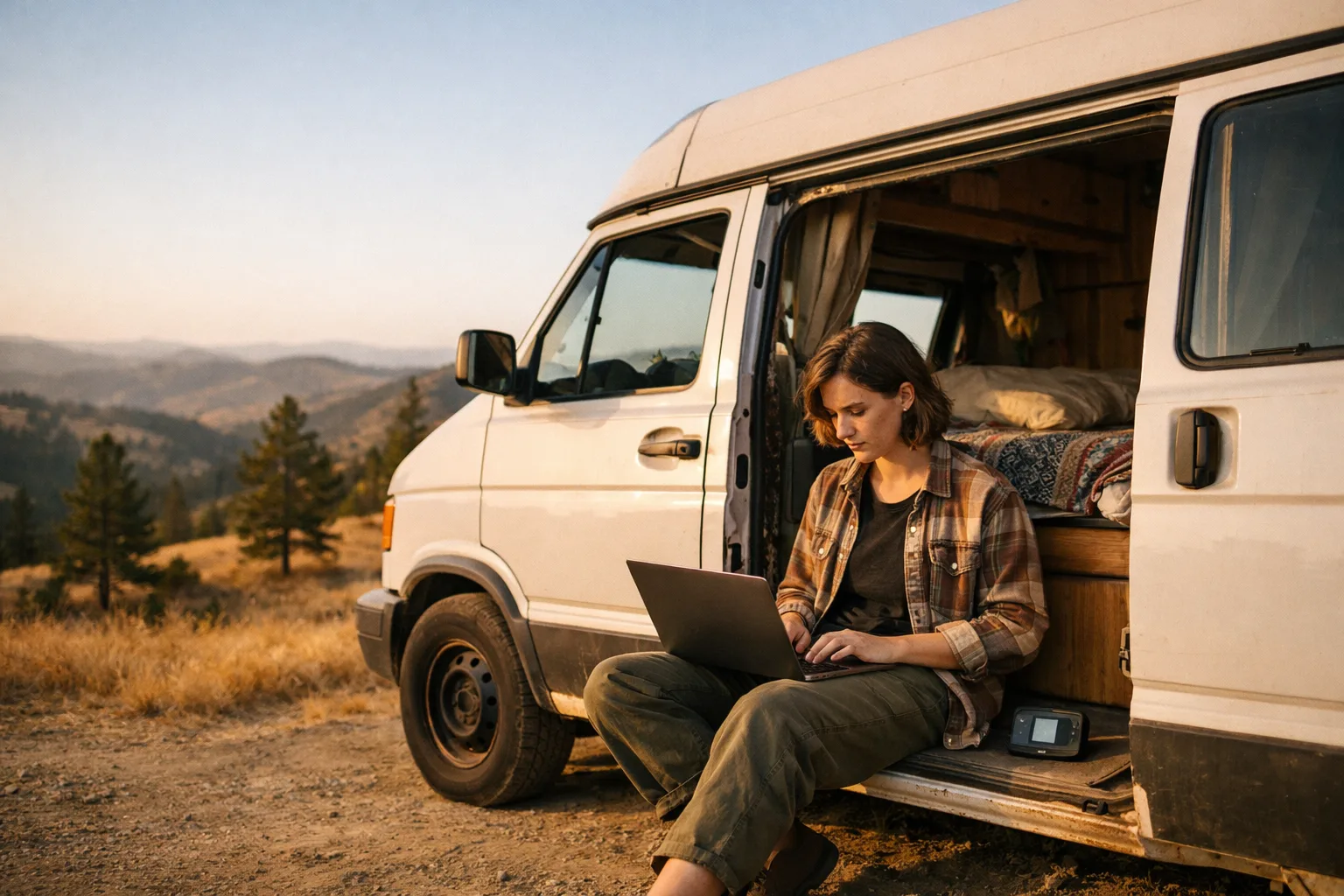

How to Work Remotely from a Van (2026 Setup Guide)
Nobody's working from the beach. But a lot of people are working from a camp chair in the desert, and it's honestly better.
Somewhere on Instagram, a person is typing on a MacBook at the edge of a turquoise infinity pool, with a caption about "my office today." That person is on vacation. They are not working from a van.
Working from a van looks like this: you're in a Walmart parking lot in Flagstaff because it's the only place with enough signal for your 2pm standup. You have two bars of LTE. Your laptop is balanced on a cutting board because your "desk" is also where you made lunch. The air conditioning is your side door, cracked open three inches because it's windy.
And weirdly, it's great. Not because of the parking lot. But because yesterday you hiked a slot canyon, tomorrow you're driving to the Grand Canyon, and right now you're getting your work done in a way that most people with a corner office would struggle to believe is possible.
Here's how it actually works.
Jobs That Work from a Van
Not every remote job is van-compatible. The ones that work best share a few traits: async-friendly communication, flexible hours, and output-based evaluation. If your boss cares when you're online versus what you deliver, van life will be a constant struggle.
The good fits
- Software development — The classic. Most dev work is async, the tools are all cloud-based, and the culture already accepts remote. You need reliable internet for git pushes and the occasional video call, but most of your day is heads-down work that doesn't care about your location.
- Design and creative work — Graphic design, UX, copywriting, video editing. Large file uploads can be a pain, but the work itself is project-based and deadline-driven, not presence-driven.
- Freelance and consulting — You set your own hours, choose your clients, and control your schedule. The tradeoff is income instability, but the flexibility is hard to beat for van life.
- Customer support (async) — Email and ticket-based support, not phone. Companies like Automattic and Zapier have fully remote support teams where response time is measured in hours, not seconds.
- Writing and content — Journalism, blogging, technical writing. You need internet to publish and research, but the actual writing can happen offline.
The tough fits
- Anything with 6+ hours of daily video calls — Your bandwidth will fail you, your background will distract people, and you'll spend your entire day optimizing for connectivity instead of actually living on the road.
- Real-time trading or finance — Millisecond latency matters, and you can't afford a dropped connection at the wrong moment.
- Highly scheduled roles — If you need to be online from exactly 9am to 5pm Eastern regardless of where you are, the time zone math alone will wear you down.
The honest answer is that most remote knowledge work can be done from a van if you're willing to plan around connectivity. The question is whether your specific job requires real-time presence or just results.
Your Workspace in 60 Square Feet
You're not going to have a standing desk, an ergonomic chair, and a 27-inch monitor. But you can get surprisingly close to comfortable with some creativity.
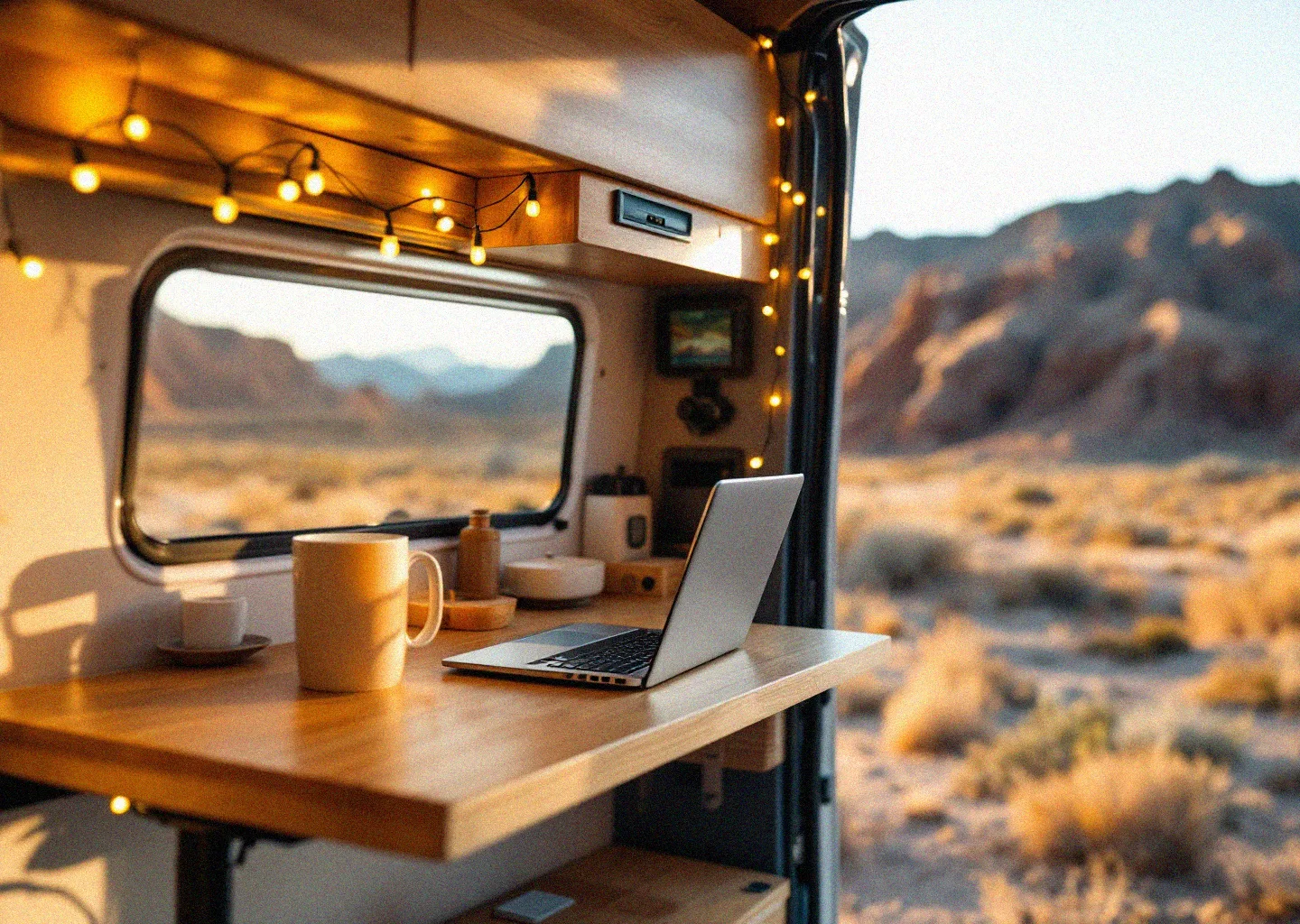
The basics
A proper surface. Working from your lap or your bed sounds fine for a day. After a week, your back will file a formal complaint. Most van workers use one of three setups: a fold-down desk mounted to the wall, a removable table that fits over the bed platform, or a Lagun swivel table mount (this is the most popular option in the van life world, and for good reason).
A chair situation. Inside the van, your options are usually the driver's seat swiveled around (if your van has swivel bases) or the edge of your bed platform. Neither is great for 8 hours. The real move is a lightweight camp chair with back support for outdoor work days. Something like a Helinox Chair One won't take up much space and gives you an actual sitting position that your spine recognizes.
A portable monitor. A 15-inch USB-C portable monitor weighs about two pounds, costs $150-200, and makes a massive difference in productivity. It's the single best work investment most van lifers make. Mount it with a small clamp arm or just prop it up next to your laptop.
Power for your workday
Your laptop uses 30-60 watts while working. Over an 8-hour day, that's 240-480 watt-hours. Add a monitor (10-15W), phone charging, and potentially a hotspot or Starlink, and you're looking at 400-700 Wh per workday.
A standard van solar setup (400W panels, 200Ah lithium battery = ~2,500 Wh usable) can handle this on a sunny day with room to spare. On cloudy days or if you're running Starlink, it gets tight. The backup plan is always driving: an hour of driving with a DC-DC charger puts back about 300 Wh, and you needed to move anyway.
Lighting and sound
Don't underestimate lighting for video calls. A dark van interior with one overhead LED makes you look like you're broadcasting from a bunker. A simple USB ring light or even just parking so your side door faces indirect sunlight solves this completely.
For calls, a pair of AirPods or any noise-canceling earbuds is non-negotiable. Wind, road noise, generators from the RV next door. The ambient noise situation in a van is unpredictable, and you need your mic to isolate your voice.
Finding Places to Work
This is the daily puzzle. Some days your van is a perfectly fine office. Other days, you need to get out, either for better internet, a change of scenery, or because it's 95 degrees and your van has become a convection oven.
Your van
On good weather days with solid cellular or Starlink signal, working from the van (or just outside it) is ideal. You have everything you need within arm's reach. The key is finding the right spot: good signal, shade if it's hot, and ideally flat ground so your laptop doesn't slide off the table.
Libraries
The absolute MVP of van life remote work. Public libraries in small towns across America have wifi, outlets, air conditioning, and bathrooms. They're free. They're quiet. And most of them have parking lots that can accommodate a van. Many full-time van workers plan their route with library stops as anchor points for heavy work days.
Pro tip: most library wifi extends to the parking lot. On nice days, you can work from your van with the doors open, using the library's wifi instead of your cellular data.
Coffee shops
The classic remote worker move, but less reliable in small towns. A specialty shop in Bend or Asheville will have fast wifi and be full of other laptop workers. A diner in rural Wyoming will give you a look if you sit there for four hours nursing a single coffee. Know your audience.
Budget $5-10 per coffee shop work session. It's a line item. Think of it as renting an office for three hours.
Coworking spaces
More and more nomad-heavy towns have coworking spaces with day passes. Sedona, Moab, Asheville, Bend, Taos, Bozeman. A day pass typically runs $20-30 and gives you fast internet, a real desk, and other humans to be around. If you're staying in one area for a week, a weekly pass is usually $80-100 and worth every dollar.
The underrated benefit of coworking spaces isn't the desk. It's the people. After days of working alone in your van, sitting in a room with other humans doing focused work is weirdly energizing. You remember what it feels like to have coworkers.
The Time Zone Problem
This is the thing nobody warns you about. You're driving west at roughly one time zone per week. Your 9am standup is now at 8am. Then 7am. Then 6am. And you're still sleepy from staying up late watching stars because you're parked in a spot with zero light pollution and you couldn't help it.
Managing it
Tell your team your "work time zone." Most remote teams don't care where you physically are. They care when you're available. Pick a time zone (usually your company's HQ or your team's majority zone) and stick to it for scheduling purposes, regardless of where your van is parked.
Front-load your meetings. If you're three hours behind your team, get your calls done in the morning and keep your afternoons free for deep work (or, let's be honest, that trailhead you've been looking at since you parked).
The "always early" rule. Set a personal policy of joining every call five minutes early. When your internet is unreliable and you might need to switch from cellular to a coffee shop's wifi mid-morning, that buffer saves you. Nobody notices when you're early. Everybody notices when you're late.
The secret to working across time zones from a van isn't discipline. It's designing your schedule so that your peak work hours overlap with your team's, and the rest of the day is yours.
The Part Nobody Talks About: Working Alone
Here's the thing about remote work from a van that the YouTube videos skip: it's lonely. Not the van life part. The working part.

In a regular remote job, you're alone in your apartment but you have a neighborhood, a gym, maybe a regular coffee shop where the barista knows your name. In a van, you're alone in a new place every few days. Your "coworkers" are on Slack. Your "office" is whatever flat surface you can find. And the social interactions that office workers take for granted, the hallway conversation, the lunch invite, the after-work drink, don't exist.
This matters more than most people expect. Loneliness isn't just a feeling. It affects your work. Isolation makes you less creative, less motivated, and more likely to burn out. Studies consistently show that remote workers who have regular social interaction are more productive than those who don't.
What helps
Find other nomads to cowork with. This is the single best thing you can do. Working alongside another person, even a stranger, even in silence, changes the entire energy of your day. It's not about socializing during work hours. It's about the coffee break, the lunch conversation, the "I'm done for the day, want to check out that trail?" at 4pm.
Stay in one place longer. The impulse is to keep moving. A new spot every day. But from a work perspective, staying somewhere for a week or two lets you build a micro-routine: the same coffee shop, the same library, maybe the same campsite neighbor who's also working remotely. Routine isn't boring when your routine includes a national park.
Schedule virtual social time. Not meetings. Social time. A weekly video call with friends back home. A Slack channel where you actually share non-work things. Remote workers who maintain social rituals outside of meetings report significantly higher job satisfaction.
Use community tools. The van life community is more connected than it looks. Between apps, forums, and gatherings, there are always other nomads nearby who are in the same situation: working from a van, craving human contact, and wondering if anyone else is parked in this campground with a laptop open.
Frequently Asked Questions
Can you work remotely from a van full-time?
Yes, you can work remotely from a van full-time, and tens of thousands of digital nomads do. The keys are: a reliable internet setup (cellular hotspot plus Starlink or strong fallback), a dedicated workspace inside the van (a swivel front seat, a fold-down desk, or a rear bench setup), a rigorous power system (300+ watts of solar plus 200+ Ah lithium battery), and discipline around routes — choosing camping spots based on cell coverage and not just scenery. Most nomads supplement van work with libraries, coffee shops, and coworking spaces.
What jobs work for van life?
The best jobs for van life are asynchronous, written-output, or video-light: software engineering, design, writing, content creation, online tutoring, data analysis, and most consulting work. Jobs with heavy meeting loads in fixed time zones, jobs requiring physical presence, jobs requiring background-check security clearances tied to a fixed address, and jobs needing reliable high-bandwidth video with multiple participants are tougher fits. Sales, customer support, and project management can work but require more route planning.
Where do van lifers work from?
Van lifers typically rotate between four workplace types: (1) inside the van with a swivel seat or rear desk setup — the most common; (2) public libraries — free, quiet, reliable wifi, almost universally available; (3) coffee shops in towns with nomad density (Bend, Sedona, Asheville, Tulum); (4) coworking spaces, increasingly available with day passes ($15-$30) in mid-sized US towns. Most nomads use a different workspace each day to avoid the cabin fever of a 60-square-foot office.
How do remote-working nomads handle time zones?
Remote-working nomads handle time zones by: (1) anchoring their work hours to one fixed time zone — usually the company's HQ time zone — and adjusting their personal schedule as they move; (2) traveling east-to-west in summer (giving you more daylight after work), west-to-east in winter; (3) being explicit with teams about which time zone you're in this week, especially for cross-time-zone meetings; (4) avoiding the impulse to chase scenic routes that put you 3+ hours offset from your team. The biggest mistake is letting your work clock drift uncontrolled.
What workspace setup works in a van?
The most common workable van workspace setups: (1) a swivel-seat front cab with a steering-wheel desk or fold-down lap desk — quickest, most flexible; (2) a permanent rear bench with a fold-up table and a 24-inch monitor — most ergonomic for full-time use; (3) the bed with a lap desk — comfortable but bad posture for full days. Essentials: external monitor (saves your neck), external keyboard, ergonomic chair or wedge cushion, ring light or window-facing seat for video calls, and noise-canceling headphones.
Find someone to cowork with on the road
nomatch shows you which nomads are nearby and what they're down for. Coffee, coworking, a hike after your last call. Stop working alone in parking lots.


Work-Life Balance (When Your Office Is Your Bedroom)
The number one risk of working from a van isn't bad internet. It's never actually stopping work.
When your laptop is two feet from your pillow and your "commute" is opening the screen, the boundary between work and life dissolves completely. You check Slack at 10pm because your laptop is right there. You start work at 6am because you woke up and your desk is your bed. You don't have a "leaving the office" ritual because you never leave.
Setting boundaries
Close the laptop at a specific time. Not "when I'm done." A time. 5pm, 6pm, whatever works. The work is never done. The emails will still be there tomorrow. Close the laptop, put it away (physically putting it in a bag or cabinet helps), and be done.
Change your environment after work. Drive somewhere different. Walk to a viewpoint. Set up your camp chair outside. Do something that physically signals the transition from work mode to life mode. Your brain needs the commute, even if it's just walking around your van.
Don't work on adventure days. If you're spending the day at a national park, leave the laptop in the van. Don't bring it "just in case." The guilt of having it nearby will pull you back, and you'll end up half-working half-hiking, which is worse than doing either one fully.
What a Week Actually Looks Like
Here's a realistic Monday-to-Friday for a remote-working van lifer. Not the ideal week. The normal one.

Monday. Wake up at a dispersed campsite in the national forest. Check signal: two bars LTE. Good enough. Make coffee, work from the van with the back doors open. Morning standup on video (camera off because your hair situation is not office-appropriate). Focused work until noon. Drive into town for a library session in the afternoon because you need to upload a large file. Groceries on the way back.
Tuesday. Same campsite. Full workday from the van. It's overcast but your Starlink handles it. Lunch is a burrito made on the camp stove. Afternoon deep work. Done at 5. Short hike to a nearby ridge before sunset.
Wednesday. Drive day. You need to move 200 miles to the next spot. Work from a coffee shop in the morning (the good one you found on Google Maps with 4.5 stars and "fast wifi" in the reviews). Drive in the afternoon. Set up at the new campsite by evening. No work after the drive.
Thursday. New campsite, new view. Check signal: nothing. Drive to the ridge 2 miles back where you had signal on the way in. Work from a pull-off with a view that would make your office-bound coworkers cry. Three video calls in a row. Laptop battery at 15% by 2pm. Drive back to camp, charge off solar, finish email on your phone.
Friday. Light meeting day. Work from the van until noon. Slack messages, code review, one call. Close the laptop at 1pm because it's Friday and there's a slot canyon two miles from your campsite. Weekend starts now.
Is every week like this? No. Some weeks you're stuck near a town because you have a project deadline and need guaranteed internet. Some weeks you're in a beautiful spot with no signal and have to drive 30 minutes each way for a library. Some weeks the weather is perfect and every workday feels like a gift. Some weeks it rains for five days and your van feels like a submarine.
But the average? The average is pretty good. You trade the predictability of an office for the freedom of choosing where you work, and most days, that trade is worth it.
Van life remote work isn't about working less. It's about working from places that make the non-work hours extraordinary.